Founder · Product Design Leader · Author
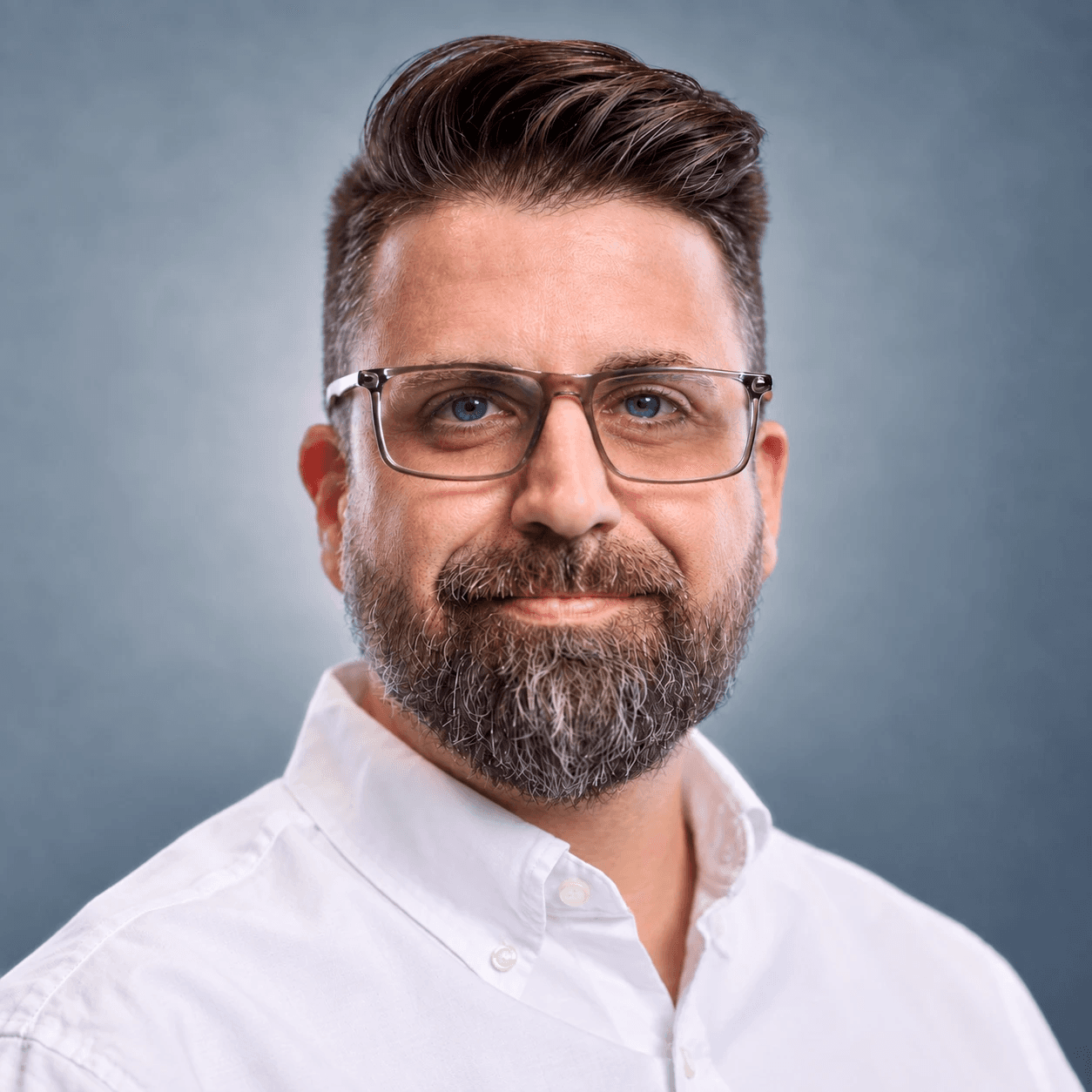
Michael D. Lapico
For thirty years, Michael has built technology designed to make things effortless. Now he is working on a harder question: how to build technology that makes people more capable, not less.
Biography
The question behind the work
Michael D. Lapico is a founder, author, and product design leader. He is the Founder and CEO of Capably Human, a mission-driven company building research, products, and institutions that advance human capability in the age of artificial intelligence.
For more than thirty years, Michael has built technology designed to make things effortless, and he started young. His family brought home a 286 computer in the winter of 1986, when he was seven, and when he had learned everything on its screen he took it apart to learn the rest. By twelve he was repairing computers and teaching the people who used them, work that became his first company, MDL Computer Services. At fifteen, soon after he first saw the World Wide Web, he was teaching HTML at MicroAge Training to a class of adults, most of them more than twice his age.
He has worked in digital since 1996, when he began building websites for local businesses. In April 1997, still in high school, he was profiled on the front of The Windsor Star’s business section, and in March 1998 he joined Outputs Web Design, one of the first web design firms in Windsor. When ICON Laser Eye Centers took the Outputs team in-house in 1999, he became its webmaster, building an online booking system for patients and streaming live laser eye surgery over the web to patients’ families. Through the 2000s he founded and led a series of digital agencies and technology businesses, carrying full responsibility for strategy, clients, operations, and P&L, and in 2002–03, alongside the first of them, he taught Interactive Multimedia to graduating graphic design students at St. Clair College, on a course he built from scratch.
In 2011 he turned to mobile. As founder and CEO of Touch Village, a mobile publisher, he brought a catalogue of apps and games to market, including KitchenPad Timer, which was featured in the Los Angeles Times and in Apple App Store curated lists. He went on to serve as Chief Product Officer at the venture-backed startups WeCam, a secure real-time communications platform built in the earliest days of WebRTC, and StoryShapr, a social storytelling platform.
He also led product design on a single smart building platform through nearly a decade of change, as it moved from a Portland startup, Ventacity Systems, into Fujitsu General Inc. and on to GENERAL Inc. Along the way he built the first UX organization in the company’s history and shaped design strategy for AIRSTAGE Cloud, its enterprise platform.
Across those roles, his work has returned to one question: how can technology expand what people are capable of doing without weakening the judgment, independence, and skill that make progress possible? That question became Capably Human, and its organizing idea, Capability Fitness: the lifelong development and maintenance of the capabilities people use to reason and decide, learn, focus, create, and adapt.
Michael is the author of The Capability Fitness Framework and The Capability Model, Capably Human’s foundational publications, and of the forthcoming book Heavy Lifting: Capability Fitness in the Age of Thinking Machines. He holds a UX Certification from Nielsen Norman Group, with specialties in Interaction Design and UX Management, and lives and works in Windsor, Ontario, Canada.
Read the full storyClose the full story
1986 · The 286
In the winter of 1986, when Michael D. Lapico was seven, his family brought home a 286 computer. It offered a prompt, a blinking cursor, and very little help, so he learned it: the operating system first, then every program he could find. When the screen had nothing left to teach him, he turned to the inside of the machine and took it apart, more than once, to the dismay of his parents and his older brothers, learning what the motherboard, the memory, and the expansion cards each did by pulling them out and seeing whether the computer still worked when they went back in. A few years later he was dialing into the bulletin board systems that came before the web, and at twelve he started one of his own, Net@Work.
1992 · MDL Computer Services
By twelve he had a reputation among his father’s business associates and friends as the person to call when a computer misbehaved, and the repairs, installations, and training became a company, MDL Computer Services, run from the family home in LaSalle, just outside Windsor. While his friends took summer jobs in fast-food restaurants, he spent his summers going from office to office, repairing computers, installing software, and above all teaching. Small and medium-sized businesses had bought computers to replace what they used to do by hand: WordPerfect for DOS was replacing the typewriter, and Lotus 1-2-3 was replacing the paper ledger with a novelty called the spreadsheet. Nearly everyone who had to use them was new to computers, and a twelve-year-old turned out to be good at explaining them.
1994 · The floppy disk
In the summer of 1994, when he was fourteen, a friend introduced him to one of the cofounders of WINCOM, a new company bringing internet access to the Windsor region. Michael had already poked around the edges of the internet in the University of Windsor’s computer centre, where he wandered while his older brothers studied, but he had never seen the World Wide Web. The cofounder switched off a demo computer, slid in a floppy disk, turned it back on, and let the modem dial out. Then he opened a web browser and went to whitehouse.gov, and Michael watched its images load at a crawl. He left with a copy of the floppy disk. At home he went straight to the web and did to it what he had done to the 286: he took it apart, reading the HTML behind each page, copying the techniques, and building pages of his own until he could make the browser do what he wanted.
1995 · The youngest teacher in the room
Before long he was asked to teach it. MicroAge Training, a Windsor centre offering accredited certifications from Microsoft and Novell, was adding the web to its curriculum, and the instructor for its first HTML course was fifteen. His students were mostly middle-aged adults entering technology for the first time, and they met him with the look of people wondering whether he was in the right room. A few classes in, the looks had gone, and everyone in that first cohort passed. It was his first experience as a teacher and not his last.
1996 · The business plan
At sixteen he began building websites for local businesses, most of whose owners had not yet heard of the internet; he described a website to them as a billboard they could own for as long as they liked, change whenever they wanted, and use to talk with their customers. In January 1997 he turned MDL Computer Services into a web design business, and as an agent for a local internet provider he could sell a client a website and a connection in one package. His first clients were real estate firms. That April The Windsor Star profiled him, a Grade 12 student at Holy Names High School, on the front page of its business section under the headline “Finishing high school a part of teenager’s business plan.” The family cut it out and laminated it.
1998 · Outputs Web Design
Early in 1998 his godfather called and asked him to come down to a coffee shop to meet someone. She was Mary-Ellen Foto, who had started Outputs Web Design around 1995 with Marc Houle and Jim Kaschak, and after hearing what he had been building she told him he needed to meet someone too. The next day he toured Outputs’ second-floor office in a historic Walkerville building and met Ghassan Barazi, who had recently acquired the firm. Barazi’s company, CAD Venture, brought computer-aided design to the region’s mould makers, and he saw web services as a natural extension for the same clients. He looked at Michael’s work and offered him a job on the spot, starting the next week. Michael accepted at once, went home, remembered he still had a month of high school to finish, and called back to explain. Barazi was amused and told him to come back in a month. He started in March 1998 as a junior web designer, a title that changed several times in the year that followed.
Outputs was a small and talented team: Foto, its creative lead; Kaschak, who ran its projects; and Houle, who took Michael under his wing, teaching him new tools, how to script a web form, and image techniques he still teaches junior designers, and who became one of his first creative inspirations. Houle has since made his name in electronic music. The firm planned, designed, built, hosted, and maintained websites for companies across southern Ontario and southeast Michigan, in years when a web page that did anything with data took tedious work. There Michael led his first project on Allaire ColdFusion, which put databases, user logins, and sessions within reach of ordinary clients and called for a new level of planning and design thinking. The client was ICON Laser Eye Centers.
1999 · Webmaster
ICON had its own tie to Outputs. Barazi had been a partner in the Windsor Laser Eye Institute, one of Outputs’ clients, and had left it to start ICON Laser Eye Centers, an early LASIK provider, with new partners. ICON’s work, which spanned websites, an intranet, patient management, and booking, soon took most of the firm’s time, and in early 1999 ICON hired the team outright. Michael left Outputs on a Friday and started at ICON the following Monday as its webmaster, then a real title, responsible for planning, designing, programming, and running everything the company did on the web. He built ICON’s corporate and consumer sites and an online booking system that brought patient consultations into its clinics. With a healthy budget for experiments, he also streamed live laser eye surgery to patients’ families from ICON’s clinic in London, Ontario: a custom-built PC took the video signal from the back of the surgical laser, and RealNetworks’ RealServer carried it to a password-protected page. It ran only with patients’ permission, and its purpose was to prove the technology, which it did.
2001–2011 · The agencies
In December 2000 he left ICON to start a design company and, on his way out the door, ran into a colleague from the sales and marketing side. The fit was obvious to both of them, and in January 2001 they founded MediaDuo, a design and marketing studio. Like most studios of the time it did everything: web applications and content management, advertising and marketing plans, print and magazine design, and radio and television spots. In September 2003 he founded Prativo Group, which he led as president until the end of 2008, and in January 2009 he co-founded Web Heads, which he led as CEO until he sold it in 2011 to focus on mobile; Web Heads is still in business. Through the decade he carried full responsibility for strategy, clients, operations, and P&L.
2002 · St. Clair College
Late in the summer of 2002, Mary-Ellen Foto, his former colleague from Outputs and by then on the faculty of St. Clair College, called to ask whether he would take over a class whose instructor had left, with the semester only a few weeks away. When he met the head of the department, he learned there was no curriculum, outline, textbook, or grading guide. He took it on anyway, though he second-guessed the decision more than once. He sourced a book and worked with the college’s librarians to get it ordered, though delays meant most students did not have it until a month into the term, and he built the course from scratch: the curriculum, the lessons, the classwork, the projects, and how they were graded. From September 2002 to May 2003 he taught Interactive Multimedia, Macromedia Flash and the fundamentals of web design, to third-year students in the Graphic Design program, in their graduating year. He turned twenty-three that fall, only a few years older than his students. All of them did well, and their final projects, fully interactive Flash websites, rivalled the work of the designers he employed at MediaDuo; one student joined MediaDuo as an intern and was later hired full time. He did not return the following year only because MediaDuo needed more of his time.
2011 · Touch Village
In February 2011 he turned fully to mobile and founded Touch Village, a publisher of apps and games. Its best-known title, KitchenPad Timer, was a visual kitchen timer in the skeuomorphic style Apple had made popular, when the iPhone’s own Notes app looked like a yellow legal pad: it opened on an oven and a stovetop, crowed like a rooster when the chicken was nearly done and mooed for the beef, and was featured in the Los Angeles Times and in Apple App Store curated lists. After a few gaming conventions he noticed that many independent developers were not marketers, and Touch Village began publishing their games too, among them Dragon’s Rage, from a studio in Ukraine, and Chin-Up, from Digital Harmony Games in Austin, Texas.
2013–2017 · Chief Product Officer
In September 2013 he joined WeCam as Chief Product Officer. WeCam began as a white-label social video app connected to the major social platforms of the day, and as an early adopter of WebRTC it offered secure, end-to-end encrypted video calls, chat, and file sharing well before that was standard. From November 2015 to January 2017 he was Chief Product Officer of StoryShapr, a social storytelling platform.
2017–2026 · One platform
In January 2017 he joined Ventacity Systems, a Portland, Oregon startup building software for smart buildings, to lead UX and product design, and stayed with that one platform through nearly a decade of change. Fujitsu General Inc. made a strategic investment in Ventacity in late 2017, and in February 2021 the engineering and product core, Michael among them, moved into Fujitsu General Inc., where the platform became AIRSTAGE Cloud and he built the first UX organization in the company’s history. The company became GENERAL Inc. on January 1, 2026.
2026 · Capably Human
Across all of it, his work kept returning to one question: how can technology expand what people are capable of doing without weakening the judgment, independence, and skill that make progress possible? It became urgent one night in March 2025, when he noticed he had handed a design problem to ChatGPT before trying it himself, and in June 2026 he began writing The Capability Fitness Framework. That work became Capably Human, which he founded to advance human capability in the age of artificial intelligence, and its organizing idea, Capability Fitness: the lifelong development and maintenance of the capabilities people use to reason and decide, learn, focus, create, and adapt. He is the author of The Capability Fitness Framework and The Capability Model and of the forthcoming book Heavy Lifting: Capability Fitness in the Age of Thinking Machines. He holds a UX Certification from Nielsen Norman Group, and he lives and works in Windsor.
Consulting
I also help companies bring AI into their products.
While I build Capably Human, I take on a small number of contract engagements: helping product teams decide which AI features are worth building, and designing experiences that leave their users better off.
Contact
Let’s talk.
For consulting, speaking, media, advisory, or Capably Human inquiries, send a note or connect on LinkedIn.
- linkedin.com/in/lapico